
India's blood banking system in 2025 looks fundamentally different from what it was in 2016.
In 2016: manual registers, phone-based donor searches, no real-time stock visibility, no national digital platform. Blood banks were institutional islands — each managing its own inventory, its own donor list, its own camp calendar, with no visibility into what any other blood bank in the city or state was holding.
By 2025: eRaktKosh connects 4,260+ blood banks. NAT testing reaches patients in remote MP districts through a hub-and-spoke model. The Rare Blood Donor Registry exists. AIIMS Guwahati has a functional Blood Centre. India collected more blood in 2024 than it needed — a national first.
By 2030, India's blood banking system is projected to look different again — through a combination of technologies, policies, and digital integrations that are either already deployed at pilot scale or in active development.
Rwanda pioneered drone blood delivery at scale. In a country of a thousand hills where roads are impassable in emergencies and each delivery takes hours by conventional vehicle, Zipline's drone network has changed the equation: blood ordered at a rural clinic arrives by drone within 30 minutes, regardless of terrain.
India has begun exploring the same model.
ICMR's Drone Blood Delivery Pilot: The Indian Council of Medical Research (ICMR) conducted a drone blood delivery to the Tangi Community Health Centre in Odisha's Khurda district. The delivery demonstrated that blood can be transported by drone to remote healthcare facilities while maintaining temperature integrity and safety standards.
This is not science fiction. It is a documented Indian pilot that has already happened.
The scenario where drone delivery would most immediately save lives in India: a mother haemorrhaging at a primary health centre in a remote district, 60 km from the nearest blood bank, on a monsoon-flooded road. Current system: hours of delay, often fatal outcome. Drone-enabled system: 20-minute delivery of O-negative packed red cells, survival.
The geography case: India's 766 districts contain hundreds of Community Health Centres and Primary Health Centres that are blood-deficit — either lacking storage entirely (80%+ of PHCs) or running too low to handle emergencies. The logistics challenge of supplying these centres by road is significant. Drones offer a fundamentally different cost curve for last-mile delivery when roads are the bottleneck.
India's Ayushman Bharat Digital Mission (ABDM) — building a national health identity system linked to Aadhaar biometrics — is being integrated with eRaktKosh and blood banking systems.
Portable donor records: A donor who has given blood in Mumbai can walk into a blood bank in Delhi and their full donation history — blood type, past donations, deferral history, TTI test results — is instantly accessible through their ABDM health ID. No need to retest, rescreen from scratch, or rely on a physical donor card.
Duplicate prevention: ABDM biometric linkage prevents the same person from donating under different names at different blood banks — a safeguard against rare fraud and a mechanism for maintaining accurate national donor statistics.
Better eligibility tracking: The 90-day interval between donations becomes automatically enforced — if a donor's ABDM-linked record shows a recent donation, the blood bank system flags the early re-donation attempt, protecting donor health.
Emergency health ID: In a trauma scenario where an unconscious patient arrives without documentation, ABDM-linked health records (if the patient has registered) could provide blood type instantly — accelerating the blood bank's ability to provide compatible blood without waiting for typing.
Artificial intelligence is beginning to enter blood banking in predictive and matching functions:
Demand prediction: AI models that analyse historical transfusion data, seasonal disease patterns (dengue outbreaks, monsoon-related trauma), hospital admission rates, and other signals can predict blood demand spikes before they occur — allowing blood banks to proactively increase collection rather than scrambling after the shortage appears.
Donor retention prediction: Machine learning models trained on donor behaviour data can identify donors at high risk of lapsing — predicting who is likely to donate again and who needs a specific type of outreach to return. This allows blood banks to concentrate their retention efforts where they will have the most impact.
Rare blood type matching: For patients with complex alloimmunisation (multiple blood group antibodies), AI can scan extended typing data across thousands of registered donors to find the best compatible match faster than manual cross-referencing.
Real-time routing: For blood banks connected on digital platforms, AI can optimise the routing of specific blood units — identifying which blood bank has the closest-to-expiry stock of a specific type and routing a requisition there first, reducing wastage and improving freshness of supply.
Beyond biometrics, ABDM is building the broader digital health infrastructure within which blood banking will increasingly operate:
Health records integration: A patient's transfusion history, blood type, and blood bank interactions will be part of their comprehensive health record — visible to treating physicians who need to know a patient's transfusion background before ordering blood.
Prescription and requisition digitisation: Digital blood transfusion requisitions — reducing the paper-based processes that still dominate blood banking in many Indian hospitals — are part of ABDM's longer-term vision.
Clinical decision support: As health records digitise, alerts to treating physicians about transfusion triggers (evidence-based haemoglobin thresholds) can be embedded in hospital systems — supporting Patient Blood Management principles at the point of clinical decision-making.
India's 2026 blood transfusion roadmap specifically targets expanding Nucleic Acid Testing (NAT) from its current concentration in well-resourced urban blood banks to comprehensive national coverage.
The MP hub-and-spoke model demonstrates that NAT can reach rural blood banks cost-effectively. As this model is replicated across other states, the blood donated by voluntary donors anywhere in India — not just in major cities — will be screened at the molecular level before reaching patients.
The implication for voluntary donors: your blood will be safer than it has ever been. The donation you make in 2030 will be screened at a sensitivity that was unavailable at most blood banks when you first started donating.
India's Ministry of Health and Family Welfare 2026 blood transfusion roadmap commits to:
These are institutional commitments, not guarantees. But the direction is clear: India's blood system is moving toward digital-first, biometrically linked, NAT-screened, drone-enabled, AI-supported infrastructure that would have seemed futuristic a decade ago.
Technology changes blood banking. It does not change the fundamental fact that blood cannot be manufactured.
No drone can deliver blood that was never donated. No AI can match a patient with a donor who never registered. No biometric system can track a donor who does not exist.
The technology makes the donation you make more effective — faster to reach patients, safer from infection, better matched to need, smarter in its use. But the donation has to happen first.
The future of blood banking in India runs through you.
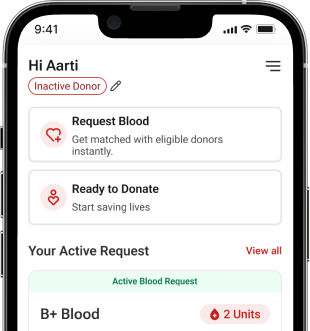
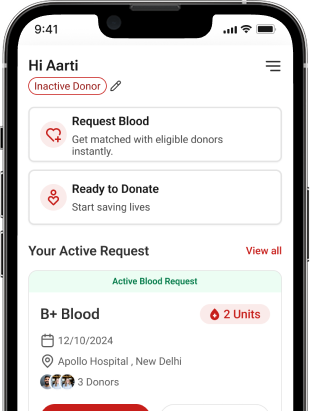
Register on TheBloodApp. Donate regularly. As India builds the 2030 blood banking infrastructure — drones, AI, ABDM integration, universal NAT — make sure your donation is part of the supply that system will optimise. To find blood donation camps and blood banks near you across India, call the number listed in the app.
Sources: Medindia — India 2026 Blood Plan | ICMR — Drone Blood Delivery Odisha | Medical Buyer — Blood Banking Transition India 2025 | WHO India Blood Safety 2024 | ORF — Securing India's Lifeblood 2025 | ABDM India | eRaktKosh MoHFW | ResearchGate — Digital Transformation Blood Banking India
Stay informed, stay inspired — your go-to source for everything about blood donation and impact.

Writing a formal letter about a blood donation camp? Use these 5 sample templates: to a principal, blood bank, company, health officer and newspaper editor.

रक्तदानाचे आरोग्यदायी फायदे मराठीत जाणून घ्या. हृदयाचे आरोग्य, लोहाचे नियमन, कर्करोगाचा धोका कमी करणे आणि बरेच काही — महाराष्ट्रातील रक्तदात्यांसाठी माहिती.

Writing a notice for a blood donation camp? Here are 5 samples in proper format for school and college students, with tips for CBSE, ICSE and state boards.


Be a part of the change — donate safely, stay connected, and help someone in need. Download the app today.
Available on