
The healthcare professional wears a bandage on their upper arm, representing a blood donation they may have made.
This is the 100th blog in TheBloodApp's blood donation series.
Over the preceding 99 blogs, we have covered India's blood donation story from every angle we could find — the history, the science, the cities, the conditions, the patients, the donors, the myths, the crises, the technology, the future. We have gone deep on platelet apheresis and granulocyte donation, on Bombay blood group and B-positive demographics, on COVID-19 lessons and Kumbh Mela logistics, on liver disease and kidney disease and maternal haemorrhage and childhood leukaemia.
Each blog was an attempt to answer a question someone, somewhere, would reasonably ask about blood donation in India. Taken together, they form something like a complete picture of why this matters — and why it matters specifically to you.
This final blog is not a new topic. It is a synthesis. A summary. A reminder.
These numbers have appeared in different forms across 99 blogs. They deserve to be stated once more, together, plainly.
14.6 million — units of blood India needs every year
74.55% — the voluntary donation rate in 2024 (the highest ever achieved)
1 million — the approximate annual shortage that still exists despite 2024's record collection
402 million — eligible blood donors in India
2.5 donations per 1,000 — the additional donation rate needed to close the gap entirely
3% — the fraction of India's eligible donors who would need to give once more per year to end the shortage
1 unit — what you can give every 90 days (men) or 120 days (women)
3 lives — the number potentially affected by a single donated unit
The gap between 402 million eligible donors and 1 million unit shortage is not a gap of capacity. It is a gap of habit, knowledge, and action.
In 100 blogs, we have written local SEO guides for:
Delhi — India's capital, AIIMS, Safdarjung, Red Cross
Mumbai — Maharashtra's megacity, Tata Memorial, KEM, J.J. Hospital
Bengaluru — IT capital, BMST's 500,000 donors, Sankalp platelet culture
Hyderabad — Pharma city, NIMS, NTR Trust
Kolkata — Bengal's heritage of voluntary donation, Tata Medical Centre
Chennai — Tamil Nadu's high-performance voluntary system, road accident burden
Ahmedabad — Prathama's 100% voluntary model, Gujarat's national trophy record
Pune — Maharashtra's youth city, IT parks, PCMC
Chandigarh — India's #1 blood banking performance city, PGIMER
Lucknow — UP's challenges, KGMU, 97.6% male donor problem
Bhopal — MP's NAT pioneer, Hamidia Hospital
Indore — India's cleanest city, NAT hub, MY Hospital
Jaipur — Rajasthan's blood desert context, SMS Hospital, new state app
Nagpur — Central India's hub, sickle cell tribal belt, AIIMS Nagpur
Guwahati — Northeast India, AIIMS Blood Centre April 2026, Billoo Ji
Visakhapatnam — Twice-weekly camp mandate, AS Raja, Divi's 23-year drive
Kochi — Kerala Bloodnet since 2012, Amrita Hospital
Thiruvananthapuram — Regional Cancer Centre, SCTIMST
Surat — SRKRC's 10,000 free thalassemia units, diamond sector donors
Coimbatore — Tamil Nadu's published annual camp schedule model
Prayagraj — Kumbh Mela logistics, MNMC, AIIMS Prayagraj
Indore — Swachh Survekshan champion, NAT hub
Fourteen specific cities. Dozens of blood banks named. Hundreds of phone numbers and addresses documented.
Blood donation serves patients across the full spectrum of medicine. In 100 blogs we have covered how voluntary blood donation directly helps:
Cancer patients — weekly platelets during chemotherapy, red cells during bone marrow aplasia
Thalassemia children — monthly transfusions from childhood through adulthood
Sickle cell patients — exchange transfusions and emergency support
Road accident victims — massive transfusion protocol, golden hour survival
Mothers haemorrhaging after childbirth — FFP, red cells, cryoprecipitate
Premature babies — irradiated O-negative for exchange transfusions
Dialysis patients — red cells for CKD anaemia
Liver transplant recipients — 20–40 units during surgery
Heart surgery patients — cardiac bypass blood requirements
Dengue patients — platelets during thrombocytopenia
Haemophilia patients — cryoprecipitate and factor concentrates from plasma
Bone marrow transplant recipients — daily support during engraftment
This is not an exhaustive list. It is a reminder that blood donation is not a special interest health cause. It is the most basic infrastructure of medicine — without it, modern healthcare cannot function.
Across 100 blogs, we have explained:
This knowledge is not academic. Every piece of it is designed to remove a barrier between a willing donor and an act of giving.
Behind every statistic in these 100 blogs is a person.
Billoo Ji — Gyan Chand Jain, oil depot worker from Bongaigaon, Assam, who has donated blood 114 times in nearly three decades.
Leela Moolgaonkar — the social reformer in 1950s Bombay who started India's voluntary blood donation movement after her son's accident.
Dr. J.G. Jolly — who founded the ISBTI in 1971, declared October 1 as National Blood Donation Day on his birthday in 1975, and spent a lifetime banning professional blood donation from India.
Basil from Vengola — who built Kerala Bloodnet from an ICU corridor at VPS Lakeshore Hospital in 2011 after his father's hospitalisation showed him the gap.
Santa Khurai — who walked into India's Supreme Court in 2021 to challenge the guidelines that permanently defer transgender persons from blood donation.
Dr. Prasun Bhattacharya — who watched his blood used on a patient the day after his first donation twenty years ago, and has been donating ever since.
Gujarat's 225+ centurion donors — quiet, persistent, giving every 90 days for decades, without fanfare.
These are the people who have kept India's blood system alive — through advocacy, through legislation, through technology, through the simple act of showing up at a blood bank, again and again.
One hundred blogs. Hundreds of thousands of words. Dozens of cities. Every blood type explained. Every patient population documented. Every myth addressed. Every barrier acknowledged.
And it all reduces to one action:=
Show up. Give blood. Come back in 90 days.
Register on TheBloodApp so that when someone in your city urgently needs your blood type, you are findable. Donate at any licensed blood bank in India — there are over 4,000 of them. Keep your haemoglobin up with iron-rich food. Return every three months.
That is it. That is the whole ask.
India has 402 million people for whom this ask is physically possible. The shortage that kills patients every day is closeable by a rounding error of that number choosing to give.
You can be part of that rounding error. You can be part of the solution. You can be the donor someone is urgently searching for right now.
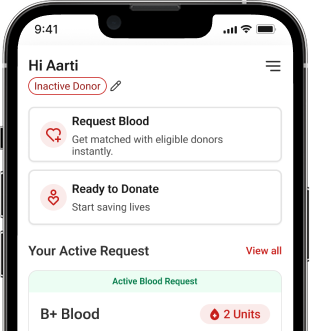
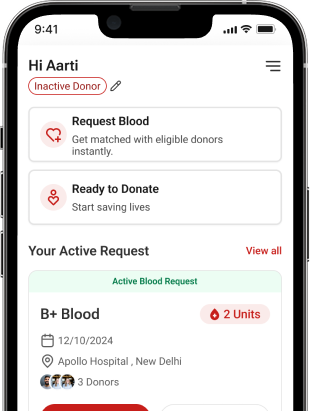
Register on TheBloodApp today. Find your nearest blood bank or donation camp across India. Give your blood. Save up to three lives per donation. Come back in 90 days. And share this with one person who might do the same. To find donation camps and blood banks near you across India — and to make an urgent blood request — call the number listed in the app.
Thank you for reading. And thank you, in advance, for donating.
Sources: All 99 preceding TheBloodApp blog posts | PLOS ONE — National Blood Demand Study India | WHO India Blood Safety 2024 | ORF — Securing India's Lifeblood 2025 | DGHS MoHFW — Blood Transfusion Services | Wikipedia — Blood Donation India | eRaktKosh MoHFW | Sankalp India Foundation | WHO Feature — Billoo Ji 2024
Stay informed, stay inspired — your go-to source for everything about blood donation and impact.
TheBloodApp has given India 100 reasons — in 100 blogs — for why voluntary blood donation matters. Here's the complete picture: what we've covered, what the data says, and the one action that matters most.

From choosing a blood bank partner to post-camp follow-up — here's everything you need to organise a successful voluntary blood donation camp at your college, office, or community.

Liver disease accounts for enormous blood demand in India — from cirrhosis-related coagulopathy to liver transplant surgery. Here's how voluntary blood donation supports liver patients and who can donate.


Be a part of the change — donate safely, stay connected, and help someone in need. Download the app today.
Available on