
In August 2025, the Indian government made an announcement that would have seemed unthinkable a decade ago: India had collected 14.6 million units of blood in 2024–25 — meeting its estimated national requirement for the first time.
A headline of national sufficiency. A genuine milestone.
But the Director of India's National Blood Transfusion Council, Dr. Krishan Kumar, accompanied that headline with a statement that deserves equal attention: "Voluntary donation is no longer just a campaign. It is a culture we are nurturing across communities. Our focus remains on strengthening quality assurance, empowering blood centres, and ensuring that every unit of blood reaches those who need it most."
The gap between the headline and the reality is where India's 2026 Blood Transfusion Plan lives.
The progress India has made in its blood system over the past two decades is genuine and measurable:
Collection growth: Annual blood collection grew from 4.4 million units in 2006–07 to 14.6 million units in 2024 — more than tripling in less than 20 years.
Voluntary donation rates: In 2006–07, only 54.4% of donations were voluntary. By 2024, that figure had risen to 74.55% — reflecting sustained campaign, policy, and cultural change.
Digital integration: The eRaktKosh platform now connects over 1,131 blood centres across India, enabling real-time stock monitoring, camp tracking, and inter-bank coordination at a national scale that did not exist a decade ago.
Rare blood donor registry: India launched the Rare Donor Registry India (RDRI) with over 4,000 screened donors tested for more than 300 rare blood markers. This enables emergency medicine teams to rapidly locate rare blood type matches — a capability that previously required guesswork and luck.
NAT testing expansion: Nucleic Acid Testing (NAT) — a more sensitive method of detecting HIV, Hepatitis B, and Hepatitis C in their earliest stages — has been expanded to more blood banks. NAT significantly narrows the "window period" during which an infection could go undetected in donated blood.
These are real achievements. They represent policy commitment, institutional investment, and the cumulative impact of millions of voluntary blood donations over years.
Following a high-level review with 36 states and union territories, the government articulated a set of priority actions for achieving universal blood access by 2026. These are not aspirational statements — they are specific, operational targets:
The bedrock goal. Today, approximately 30% of India's blood still comes from replacement donors — family members donating under pressure in hospital corridors. The 2026 plan calls for eliminating this entirely.
This requires not just policy, but cultural change: expanding the voluntary donor base, building retention systems, and providing alternatives to replacement donation in every district of the country.
10% of districts still lack a functional blood centre. Many facilities that exist are not yet fully integrated into the eRaktKosh platform, meaning their stock information is not visible to hospitals and patients searching for blood in real time.
The 2026 plan calls for 100% licensing compliance — every operational blood centre meeting legal and safety standards — and full digital integration so that no blood centre is invisible to the national tracking system.
All blood collected in India must be screened for five Transfusion Transmitted Infections (TTIs): HIV I & II, Hepatitis B, Hepatitis C, Syphilis, and Malaria. The 2026 plan strengthens compliance monitoring for this requirement and expands access to NAT for high-risk populations.
One of the most significant structural proposals is shifting responsibility for blood supply management from state-level to district-level administration. Rather than districts depending on state blood banks, each district would manage its own collection, storage, and distribution capacity.
This means:
The 2026 plan calls for enforceable national standards for blood collection camps — ensuring that camps held outside blood bank premises (in colleges, offices, community halls) meet the same clinical quality standards as hospital-based collection.
This is particularly important because camps account for a large proportion of India's voluntary blood collection — and camp quality has historically varied significantly.
Recognising that institutional campaigns alone cannot reach the populations most in need of blood donation awareness — particularly in rural and semi-urban areas — the 2026 plan promotes community-based approaches that embed donation within local social structures.
This aligns with what the best-performing states already do: leveraging neighbourhood organisations, religious institutions, trade unions, and self-help groups to recruit and retain donors at the community level.
Blood testing quality varies across India's more than 2,700 blood banks. A National EQA programme would establish external benchmarks and monitoring to ensure that the testing done at a small-town blood bank is as reliable as that done at a metropolitan medical college.
The 2026 ambitions are bold. They must be assessed against the structural realities that make them challenging:
The BMJ Global Health study found that only 26% of residents in eight EAG states live within 30 minutes of a blood bank. Building blood banking infrastructure in the districts that lack it will require sustained capital investment and trained human resources — both of which are challenging at scale.
India's blood collection is still heavily driven by college camps. When campuses close, collections fall. The 2026 plan's community-based recruitment approach is a step toward diversifying the donor base — but the seasonal slump will persist until habits, not events, drive donation.
Replacement donation persists because voluntary blood is not always available when patients need it. Eliminating replacement donation requires having enough voluntary blood in stock before emergencies occur — a circular challenge that requires simultaneously building supply and reducing dependency.
Moving blood banks from paper registers to eRaktKosh requires hardware, training, and sustained administrative attention. With 10% of districts lacking even a blood centre, the integration agenda starts from an uneven baseline.
The government's 2026 plan is ambitious, well-directed, and supported by real data. But it cannot succeed without the fundamental ingredient that no government programme can manufacture: people choosing to donate blood voluntarily, regularly, year-round.
Every structural improvement — better digital integration, more blood centres, stricter camp standards, expanded NAT testing — multiplies in value when there are more voluntary donors to work with.
A fully integrated national blood network with 10 million voluntary donors is less useful than a partially integrated one with 30 million.
The 2026 plan creates conditions for the blood system to work better. You create the blood that flows through it.
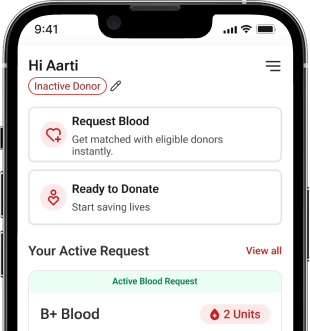
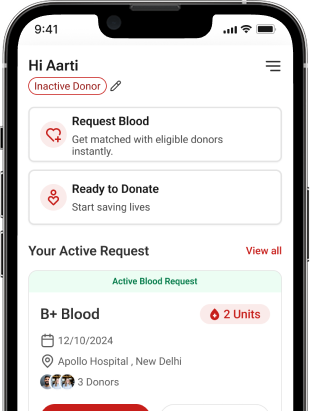
TheBloodApp is built around exactly the priorities that India's 2026 blood plan identifies:
The goals of India's 2026 Blood Transfusion Plan and the mission of TheBloodApp are aligned. One is a policy framework. The other is a practical tool. Both need you.
Register on TheBloodApp today. Donate voluntarily, regularly, and with commitment. Be part of India's 2026 blood mission — not as a statistic, but as a donor. To find blood banks and donation camps near you across India, call the number listed in the app.
Sources: WHO India — India Strengthens Blood Safety 2024 | Medindia — India's 2026 Blood Transfusion Plan | Ministry of Health and Family Welfare India | Observer Research Foundation — Securing India's Lifeblood 2025 | NBTC India | BMJ Global Health — Blood Deserts Study 2024 | IndiaSpend — Is India Blood Sufficient? 2026
Stay informed, stay inspired — your go-to source for everything about blood donation and impact.

Had a drink last night? Planning to donate tomorrow? Here's how long to wait after drinking alcohol before donating blood in India — and why the rule exists.

रक्तदान करने से मरीजों की जान बचती है — लेकिन दाता को भी कई स्वास्थ्य लाभ होते हैं। हृदय स्वास्थ्य, कैंसर का कम खतरा, मुफ्त स्वास्थ्य जांच और भी बहुत कुछ।

Worried about blood group compatibility before marriage? ABO type has no bearing on it, but the Rh factor does matter in pregnancy. Here's the full picture.


Be a part of the change — donate safely, stay connected, and help someone in need. Download the app today.
Available on