
Man donating blood and the nurse collecting it in a blood bag.
Ask anyone who has donated blood multiple times what keeps them coming back, and the answers cluster around two things: a sense of purpose (knowing the donation matters), and a sense of belonging (feeling that the act is seen and valued by others).
Recognition does not sound like a medical priority. But in blood banking, it is — because the biggest systemic challenge is not first-time donation, it is repeat donation. The 73% of Indian donors who give once and never return represent the most significant leverage point in the system. Converting even a fraction of them into regular donors would close India's one-million-unit annual shortage.
Recognition programmes are one of the most evidence-based tools for improving donor retention. And India has a layered set of them — from the highest national level down to the donor card in your wallet.
The NBTC, under the Ministry of Health and Family Welfare, recognises voluntary blood donors through national awards announced on National Voluntary Blood Donation Day (October 1) and World Blood Donor Day (June 14).
These awards acknowledge donors who have made extraordinary contributions — typically centurion donors or those who have sustained voluntary donation over decades. Award recipients may be invited to national events, receive citations from senior government officials, and are publicly recognised in government communications.
Each year, the President of India presents the National Blood Donation Trophy to the Red Cross State Branch that achieves the highest voluntary blood donation in the country. This award — won by the Gujarat Red Cross Society for 25+ consecutive years — is the most visible national recognition for institutional blood donation performance.
While this is an institutional award rather than an individual donor award, it has a powerful community effect: in Gujarat, being part of the voluntary donor base that wins the national trophy is a source of community pride that reinforces donation culture at the individual level.
State governments recognise their own voluntary blood donors on October 1 and June 14 through:
In Tripura — India's top-performing voluntary donation state — the Chief Minister personally donated blood and publicly acknowledged voluntary donors at state functions. This top-level participation signals that blood donation is a civic priority, not just a public health campaign.
Prathama Blood Centre — which meets 50% of Ahmedabad's blood needs through 100% voluntary donation — actively recognises donors who cross milestone numbers. The centre's community of centurion donors is celebrated within the institution, creating visible role models for newer donors.
The recognition model at Prathama is part of what has built a voluntary donor community of 250,000+ registered donors in Ahmedabad — one of the highest blood donation to population ratios in India.
Sankalp India Foundation — one of India's most innovative blood donation NGOs, known for building the IT sector platelet donation community in Bengaluru — runs a digital recognition system for its donors. Milestone donations are tracked, shared on social platforms, and acknowledged within the Sankalp community.
Sankalp's approach treats blood donation as a social identity, not just a health behaviour. Donors are proud to share their milestones. The community aspect — the sense of belonging to a group of people who give — is deliberately engineered into the Sankalp model.
The Indian Red Cross Society issues voluntary blood donor cards to registered donors. The card serves multiple functions:
The priority access provision — a free unit of blood when the donor needs it — is among the most practically meaningful benefits available to voluntary blood donors in India. It converts blood donation from a purely altruistic act into a form of mutual aid: I give when healthy, I receive priority when I need it.
The national eRaktKosh platform is increasingly integrating donor history tracking. Registered donors who use eRaktKosh can view their donation history, receive reminders when eligible to donate again, and see their cumulative impact.
As eRaktKosh matures, the platform has the infrastructure to evolve into a national voluntary donor recognition system — one that tracks milestones, issues digital acknowledgments, and makes donation history visible and portable across blood banks nationwide.
The evidence base for recognition as a donor retention tool is consistent across countries and contexts:
Milestone recognition works. Donors who are told "this is your 10th donation" at the time of their 10th donation are significantly more likely to return for an 11th than donors who receive no acknowledgment. The milestone itself creates meaning that the routine act of donation does not generate on its own.
Social recognition is more powerful than private recognition. A certificate handed privately creates a small identity reinforcement. A certificate handed publicly — at a community event, in front of peers, with a handshake from a civic leader — creates a social identity as "a blood donor." That social identity is self-reinforcing.
Reciprocity matters. The IRCS donor card's blood priority provision is not just a benefit — it is a form of institutional acknowledgment that your donation is valued and that the relationship is mutual. Donors who feel reciprocally valued are more likely to maintain long-term commitment.
Community belonging reduces attrition. Donors who are part of a recognised community of donors — who know other donors, who see themselves as part of a group — return at higher rates than isolated, anonymous donors.
Beyond certificates and awards, voluntary blood donors in India receive several concrete benefits:
Free health screening at every donation: Blood pressure, pulse, temperature, and haemoglobin checked every 90 days at no charge. For millions of Indians without access to regular preventive healthcare, this is a genuine health benefit.
Priority blood access (IRCS): IRCS donor card holders are entitled to one free unit of blood when they or their family members need it. In India's often-costly blood access landscape, this is practically meaningful.
Corporate recognition: Many companies track CSR blood donation participation and include blood donation in their employee wellness recognition programmes. Some offer half-day leave for blood donation visits.
Community status: In communities where blood donation culture is strong — Gujarat, Tripura, Bengaluru's IT sector — regular donors carry a form of social capital. Being known as "someone who donates blood regularly" carries genuine social recognition.
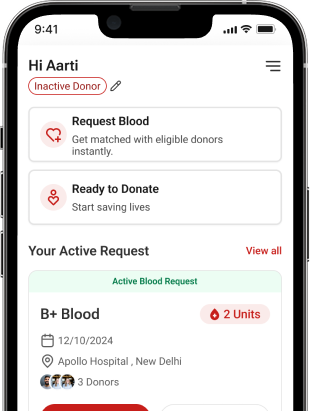
TheBloodApp tracks your donation history — recording each donation date, blood type, and location. This enables:
The app also connects you to the larger community of Indian blood donors — making visible the network of people who share this habit.
Recognition does not make blood donation meaningful on its own. The meaning comes from the act itself. But recognition makes the act visible — to yourself, to your community, and to the institutions whose work your donation sustains.
Register on TheBloodApp. Every donation is recorded. Every milestone will be marked. Start building your donor history today. To find blood banks and camps near you across India, call the number listed in the app.
Sources: NBTC India — Donor Recognition Programmes | IRCS — Voluntary Donor Card Benefits | Prathama Blood Centre Ahmedabad | Sankalp India Foundation — Donor Recognition | WHO India Blood Safety 2024 | Abbott India — Dr. Prasun Centurion Story | PMC — Voluntary Blood Donation India Achievements | ORF — Securing India's Lifeblood
Stay informed, stay inspired — your go-to source for everything about blood donation and impact.

From choosing a blood bank partner to post-camp follow-up — here's everything you need to organise a successful voluntary blood donation camp at your college, office, or community.

Liver disease accounts for enormous blood demand in India — from cirrhosis-related coagulopathy to liver transplant surgery. Here's how voluntary blood donation supports liver patients and who can donate.

O positive (O+) blood can go to any Rh-positive recipient — 97% of the population. India needs approximately 4.4 million units of O+ blood annually. Here's why O+ donors are critically important.


Be a part of the change — donate safely, stay connected, and help someone in need. Download the app today.
Available on