
India's blood supply is, in almost every meaningful sense, a young person's system.
A study of donors at Uttar Pradesh University of Medical Sciences found that 87.9% of donors were aged 18–34. This is not a surprise — younger adults meet eligibility criteria more readily, have higher haemoglobin levels on average, and are more likely to be recruited through college and university-based donation camps, which account for a disproportionate share of India's voluntary collections.
Young people are, genuinely, the backbone of India's blood supply.
And there lies the problem.
Because 73% of India's voluntary blood donors donate only once. One donation. One record in the database. And then they are gone.
India collects 14.6 million units of blood per year. That is a number that sounds large until you realise that the eligible donor pool is 402 million people — and the country still runs a shortage of approximately one million units annually.
The shortage exists not because there are too few eligible donors, but because too few of them donate regularly. The Observer Research Foundation's analysis of India's blood supply is direct about this: "Most donations are on an occasional basis and are reactive in nature. National drives are successful in attracting new donors, especially students. However, the level of repeat donation continues to remain meagre."
This is the retention crisis. And it falls hardest among the young donors who make up the overwhelming majority of India's donor pool.
Most donors donate at a college camp, receive a biscuit and a certificate, and then hear nothing for months. The blood bank has no mechanism to remind them when they are eligible again (after 90–120 days). By the time 90 days have passed, the donation feels like a memory rather than the start of a habit.
A donor who receives no information about what happened to their blood — which patient it reached, what condition it helped — has no emotional reinforcement for the act. Studies on prosocial behaviour consistently find that feedback increases repeat behaviour. Donation without impact narrative is donation without an engine for repetition.
Counter-intuitively, some donors who found the experience more uncomfortable than expected (lightheadedness, bruising, nervousness) do not return because the memory of discomfort outweighs the memory of having helped. Proper post-donation care — and honest pre-donation preparation — can mitigate this significantly.
For the first donation, a college camp brings the blood bank to the donor. The second donation requires the donor to go to the blood bank independently. For many young Indians — managing studies, work, commutes, and crowded city living — this additional step is enough friction to prevent follow-through.
A significant number of donors who gave once believe they cannot give again for a year or more. The actual NBTC guideline is 90 days for men and 120 days for women. Confusion about frequency is one of the most easily corrected but widely under-addressed barriers to repeat donation.
The data on who donates in India is telling:
A retrospective analysis from UPUMS Blood Centre in Uttar Pradesh (covering 45,067 donors from 2018 to 2023) found:
The gender imbalance reflects both physiological barriers (anaemia as a common deferral reason for women) and cultural barriers (women in many parts of India are not proactively recruited for blood donation). A 2011 national study found that only 6% of India's blood donors were women — a number that has improved but remains far from representative.
The 73% first-timer figure means that for every new donor entering the system, India is retaining fewer than three in ten as repeat donors. To sustain supply, the system must continuously recruit enormous numbers of new first-timers to replace the donors who donate once and disappear.
This is a fundamentally unstable model.
Research on blood donor retention — globally and in India — consistently identifies the same set of factors that distinguish repeat donors from one-time donors:
Personal identity as a donor: Donors who describe themselves as "a blood donor" — not just "someone who donated once" — are far more likely to donate repeatedly. This identity formation is fostered by recognition, community, and positive experience at the donation point.
Social networks: Donors who have friends or colleagues who also donate are significantly more likely to return. Peer influence that got them to donate the first time can sustain the habit if those peers are also regular donors.
Institutional reminders: Donors who receive timely reminders when they are eligible again (90–120 days after their last donation) show markedly higher return rates. This is precisely the kind of functionality that blood donation apps provide.
Positive experience at the blood bank: A friendly, efficient, well-organised donation experience — where donors feel respected and appreciated — is the strongest predictor of return. Donors who feel like a burden or who wait hours in a disorganised queue rarely come back.
Recognition and acknowledgment: Even a simple thank-you message after donation increases return rates. Certificates, badges, and public acknowledgment create social reinforcement for the behaviour.
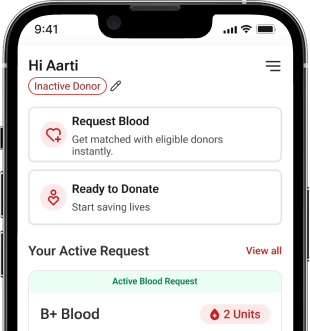
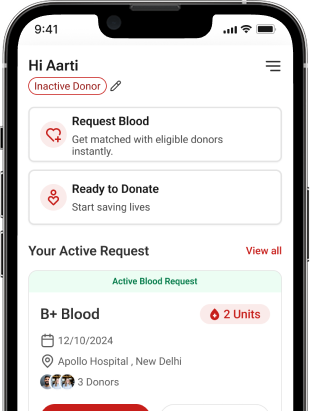
This is where technology — specifically platforms like TheBloodApp — changes what is possible.
Traditional blood banking systems had no infrastructure for donor follow-up. A donor gave, their record went into a database, and the blood bank had no practical way to reach them three months later to say, "You're eligible again. Someone needs your blood type in your area."
Blood donation apps solve this:
Eligibility reminders — TheBloodApp tracks your last donation date and sends you an alert when you are eligible to donate again. This single feature, applied at scale, could significantly close the retention gap.
Urgent need alerts — When a hospital near you urgently needs your specific blood type, you receive a notification. This creates an emotional urgency that a general reminder cannot replicate. Receiving an alert that says "a patient at [Hospital] needs O+ blood urgently" is a fundamentally different experience from receiving a calendar reminder.
Donation history tracking — Donors who can see their own donation history — how many times they have given, what their haemoglobin trend looks like, how many lives they have potentially impacted — are more invested in continuing.
Community and recognition — Apps that show donors their rank among local contributors, or that send milestone notifications (first donation, third donation, one year of donating), create the social identity reinforcement that drives habitual behaviour.
Camp discovery — Making it trivially easy to find a donation camp near you removes the friction of the second donation. The first donation came to you at a college camp. The app brings the camp to you digitally, wherever you are.
Young donors are recruited primarily in educational and workplace settings. These institutions have a corresponding responsibility to nurture donors beyond the first donation:
If India's first-time donor retention rate improved from 27% to just 40%, the number of repeat voluntary donors in the system would grow dramatically — reducing the seasonal slumps, reducing reliance on replacement donation, and closing the one-million-unit annual gap.
These are achievable numbers. The barriers are not structural. They are friction, follow-up, and feeling valued.
Young India donates. It just needs to be asked again — at the right time, through the right channel, with the right message.
Register on TheBloodApp today. Donate once. Let the app remind you to donate again. Be one of the one in four who comes back — and help change the ratio. To find donation camps near you across India, call the number listed in the app.
Sources: PMC — Retrospective Analysis of Blood Donors, Rural UP, 2018–2023 | Observer Research Foundation — Securing India's Lifeblood (2025) | Wikipedia — Blood Donation in India | WHO India Blood Safety Report 2024 | PLOS ONE National Blood Demand Study | IndiaSpend — Blood Donation Statistics India
Stay informed, stay inspired — your go-to source for everything about blood donation and impact.

Had a drink last night? Planning to donate tomorrow? Here's how long to wait after drinking alcohol before donating blood in India — and why the rule exists.

रक्तदान करने से मरीजों की जान बचती है — लेकिन दाता को भी कई स्वास्थ्य लाभ होते हैं। हृदय स्वास्थ्य, कैंसर का कम खतरा, मुफ्त स्वास्थ्य जांच और भी बहुत कुछ।

Worried about blood group compatibility before marriage? ABO type has no bearing on it, but the Rh factor does matter in pregnancy. Here's the full picture.


Be a part of the change — donate safely, stay connected, and help someone in need. Download the app today.
Available on