
First-time donors almost always say the same thing afterward: "That was it? That's all it was?"
The entire process — from walking in to walking out — takes roughly 45 minutes to an hour. The actual blood collection takes 8–10 minutes. Most of that time is spent on health checks designed to protect you, not extract anything from you.
And yet, for many Indians, the unknown of what happens inside a blood bank is enough to keep them from ever going. If that uncertainty is what's stopping you, this is for you — a completely honest account of exactly what happens, step by step, from arrival to recovery.
You do not need to do anything complicated before donating blood. But a few simple steps make the experience smoother and your donation more useful:
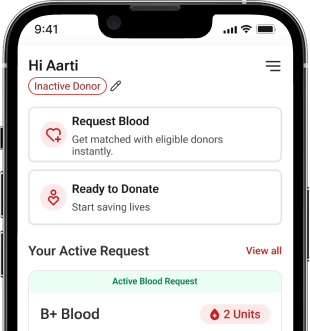
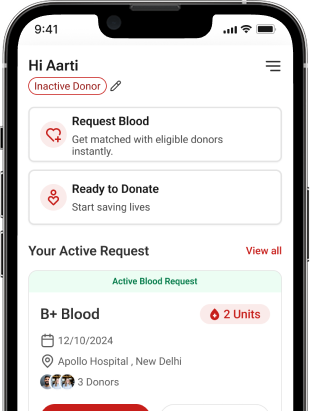
You can use TheBloodApp to locate the nearest blood bank or upcoming donation camp in your city before you go, and register online to save time at the centre.
When you arrive at the blood bank or donation camp, you go to a registration counter. Here you:
Staff are trained to be welcoming to first-time donors. Do not hesitate to tell them it is your first time — they will guide you through every step.
A trained staff member or doctor will ask you a series of questions about your health and lifestyle. These are confidential — your answers do not go anywhere except the blood bank's secure records.
The questions cover:
Answer honestly. These questions are not a barrier — they are a filter designed to protect the person who will eventually receive your blood. If something disqualifies you today, staff will tell you when you can return.
After the questionnaire, a quick physical check is done:
Haemoglobin test: A tiny drop of blood is taken from your fingertip using a small lancet (a quick prick — briefer and less painful than a blood pressure check). This checks your iron levels. You need a minimum of 12.5 g/dL to donate. If your haemoglobin is too low, you will be advised to eat iron-rich foods and return in a few weeks.
Blood pressure: Measured with a standard cuff. Must be within normal ranges (systolic 100–140 mm Hg, diastolic 60–90 mm Hg).
Pulse: Counted manually or with an oximeter. Should be 50–100 beats per minute without irregularities.
Temperature: Taken orally or with a digital thermometer. Must not exceed 37.5°C.
Weight check: If not already confirmed, staff verify you are at least 45 kg.
All of these take just a few minutes. The whole pre-donation screening — questionnaire plus physical check — is typically done within 15 minutes of arrival.
This is the main event — and the part most people worry about unnecessarily.
You are directed to a donation chair or bed where you sit or lie comfortably. A cuff is placed around your upper arm to make the vein prominent. The inner elbow area is cleaned thoroughly with an antiseptic.
The phlebotomist (trained blood bank technician) inserts a sterile, single-use needle into the vein. This is the moment of maximum discomfort — a quick, sharp pinch lasting about two seconds.
After that? Nothing. Blood flows through the needle into a sterile collection bag already containing anticoagulant to prevent clotting. You feel no pain. Many donors chat with staff, look at their phones, or simply relax.
India's standard donation volume is 350–450 ml of whole blood — less than a tenth of the roughly 5 litres in your body. The bag fills in 8–10 minutes.
When collection is complete, the needle is removed. A cotton ball or bandage is placed on the site. You apply gentle pressure for a minute or two. No stitches. No wound. A small bandage stays on for a few hours.
Each needle is used exactly once and immediately disposed of. There is zero risk of infection from the equipment.
This step is mandatory — do not skip it in a hurry to leave.
You are directed to a rest area where you sit quietly for 10–15 minutes. Staff bring refreshments: usually biscuits, juice, glucose drink, and water. Eat and drink them — they stabilise your blood sugar and help your body begin the fluid replacement process.
This brief rest is when the rare case of lightheadedness is most likely to occur, which is exactly why you stay seated under observation. If you feel dizzy, lie down immediately and tell a staff member. It passes quickly and is entirely manageable.
Most donors feel fine within minutes. Some feel a slight sense of fatigue for the rest of the day, which is normal.
After the rest period, you receive:
For the next 24 hours:

If you feel faint after leaving, sit or lie down immediately. Call the blood bank if you have any concerns — they are always reachable.
Your blood is not simply bottled and handed to a patient. It goes through a careful post-collection process:
Only blood that passes all infectious disease tests is released for transfusion. Every step is documented and traceable.
After donating, your blood group will be on record. You will be contacted when blood of your type is urgently needed nearby — especially if you register on TheBloodApp, which enables real-time alerts to donors based on location and blood type.
Men can return after 90 days. Women after 120 days. Regulars who donate every cycle are the backbone of India's blood supply — every unit you give consistently is worth more than five spontaneous one-off donations spread over years.
Register on TheBloodApp, find a blood bank or donation camp near you in Delhi, Mumbai, Bengaluru, Chennai, Hyderabad, Kolkata, Pune, or across India. To book your first donation or ask questions, call the number listed in the app.
Sources: NBTC India — Donation Process | eRaktKosh Ministry of Health | Apollo Hospitals Blood Donation Guide | Fortis Healthcare Blood Donation Guide | Red Cross — Donation Process Overview | NACO Voluntary Blood Donation Guidelines
Stay informed, stay inspired — your go-to source for everything about blood donation and impact.
Had a drink last night? Planning to donate tomorrow? Here's how long to wait after drinking alcohol before donating blood in India — and why the rule exists.

रक्तदान करने से मरीजों की जान बचती है — लेकिन दाता को भी कई स्वास्थ्य लाभ होते हैं। हृदय स्वास्थ्य, कैंसर का कम खतरा, मुफ्त स्वास्थ्य जांच और भी बहुत कुछ।

Worried about blood group compatibility before marriage? ABO type has no bearing on it, but the Rh factor does matter in pregnancy. Here's the full picture.


Be a part of the change — donate safely, stay connected, and help someone in need. Download the app today.
Available on