
Lab technician places labeled blood samples in refrigerator for safe preservation.
This is not a blog anyone wants to need.
But the reality of India's blood banking system — one million units short annually, blood deserts across northern and northeastern India, seasonal shortages in every major city — is that many families will find themselves in a hospital corridor being told that the blood bank does not have the blood their relative needs right now.
When that happens, panic is natural. It is also the enemy of the systematic approach that actually gets blood faster.
This guide is for that moment. It is written as a practical action sequence: what to do first, what to do second, and who to call in what order. It is also written as something to read before that moment — so that if it ever comes, you are not starting from zero.
Before you start making calls, you need three pieces of specific information from the treating doctor or blood bank:
1. The blood type required — ABO and Rh factor (e.g., B-positive, O-negative, AB-positive)
2. The component required — Whole blood, packed red blood cells, platelets, fresh frozen plasma, or cryoprecipitate. Different components come from different sources and have different shelf lives. "Blood" is not specific enough.
3. How many units — 2 units, 4 units, 10 units. This determines whether one donor is enough or whether you need multiple donors or a blood bank transfer.
4. The hospital name, ward, and patient name — For verifying requests to blood banks and donors.
5. The timeline — "Needed by 5 pm today" versus "needed before surgery tomorrow morning" determines your urgency level and approach.
Write these down. Share them accurately with everyone you contact. Inaccurate information delays matching.
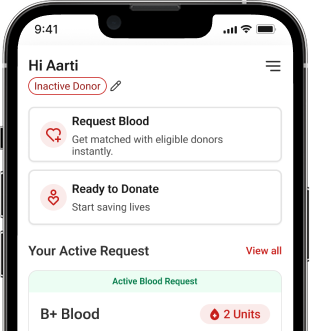
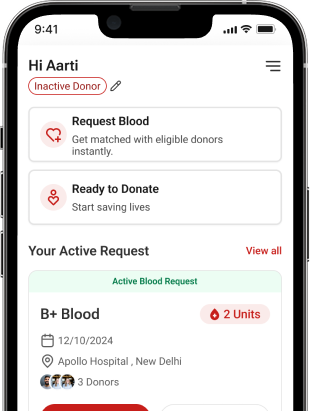
Open TheBloodApp and submit an urgent blood request immediately. Enter the blood type, component, hospital, and timeline.
TheBloodApp sends targeted alerts to registered voluntary donors matching the required blood type within a geographic radius of the requesting hospital. Unlike WhatsApp broadcasts that reach everyone indiscriminately, this alert reaches exactly the right people — registered, verified donors of the matching type who are within reach.
This step costs nothing. It takes two minutes. Do it first, before making any other calls, because voluntary donors who have registered specifically to respond to these alerts may be able to reach the blood bank faster than any institutional coordination.
For urgent blood requests, call the number listed in TheBloodApp for additional assistance.
Open eraktkosh.mohfw.gov.in or the eRaktKosh app on your phone.
The results show which blood banks within your district currently have stock of the required component, with approximate unit counts and contact information.
This step tells you whether the blood you need is sitting in another blood bank nearby — a situation that requires coordination between hospitals rather than finding a new donor. If another blood bank in the city has stock, the treating hospital's blood bank officer can arrange a transfer. You may need to help facilitate by calling the stocked blood bank directly.
Note on eRaktKosh accuracy: Major city blood banks update stock frequently; smaller or rural blood banks may not update in real time. If a blood bank shows stock, call to confirm before sending someone there.
Ask the blood bank medical officer specifically:
Blood bank officers have institutional networks that families do not — they know which nearby blood banks have stock and can make blood-bank-to-blood-bank transfer requests faster than you can coordinate individually.
Your city's Indian Red Cross Society branch and the State Blood Transfusion Council (SBTC) are coordination bodies whose purpose includes exactly this kind of emergency.
IRCS branches in major cities:
The SBTC for your state (Maharashtra SBTC, Karnataka SBTC, SBTC UP, etc.) maintains state-level coordination and can escalate to a broader geographic search if local stock is genuinely unavailable.
Contact details for IRCS branches and SBTCs are available through eRaktKosh and the NBTC website.
Now — only after taking the structured steps above — activate your personal network.
Why now and not first? Because broadcasting to everyone before you know the blood type and component often generates a flood of responses from people who cannot help (wrong blood type), overwhelming you with communication at the moment when you least have capacity for it.
The correct way to broadcast on WhatsApp or social media:
Create a message with:
Send this to:
Ask everyone who forwards to keep the specific details intact. A vague forwarded message saying "someone needs blood" generates confusion; a specific message generates useful responses.
If the blood type is rare — O-negative, AB-negative, B-negative, or any Rh-negative type — you may need to search beyond your city.
TheBloodApp can expand the donor search radius for rare types — contacting registered donors across a wider geographic area.
RDRI (Rare Donor Registry of India) — for genuinely rare types like Bombay blood group or extended antigen-negative donors, the blood bank medical officer can contact the RDRI through NBTC channels.
State capital blood banks — If your district blood bank cannot source rare blood, the state capital's main government hospital blood bank (AIIMS, government medical college) typically maintains larger rare type reserves or has coordination with more extensive voluntary donor registries.
If the blood need is for planned surgery (not an emergency), and if there is sufficient time before the procedure:
These options reduce donor dependency and alloimmunisation risk. Discuss them with the surgical team early in the planning process.
If all steps above are exhausted and blood cannot be sourced within the required timeline, return to the treating doctor with this information. The physician may:
Never accept "blood not available" as a final answer without systematically checking all available channels. But also: honest, systematic escalation through institutional channels (blood bank officer → IRCS → SBTC) is more likely to resolve the situation than individual panic.
The best time to read this guide is before you need it. Here is what to do now:
The preparation that prevents the worst of this crisis is simply being a registered voluntary donor before the crisis begins.
Register on TheBloodApp. Know your blood type. Donate regularly. And share this guide with anyone who might need it before they do. To find blood donation camps and blood banks near you across India, call the number listed in the app.
Sources: eRaktKosh MoHFW | NBTC India | IRCS India | ORF — Securing India's Lifeblood | PMC — Digital Transformation Blood Banking India | Blood Science — COVID Blood Transfusion Lessons | Wikipedia — Blood Donation India | WHO India Blood Safety 2024
Stay informed, stay inspired — your go-to source for everything about blood donation and impact.

From choosing a blood bank partner to post-camp follow-up — here's everything you need to organise a successful voluntary blood donation camp at your college, office, or community.

Liver disease accounts for enormous blood demand in India — from cirrhosis-related coagulopathy to liver transplant surgery. Here's how voluntary blood donation supports liver patients and who can donate.

O positive (O+) blood can go to any Rh-positive recipient — 97% of the population. India needs approximately 4.4 million units of O+ blood annually. Here's why O+ donors are critically important.


Be a part of the change — donate safely, stay connected, and help someone in need. Download the app today.
Available on