
India collects 14.6 million units of blood a year. It needs every single one of them — and more.
Despite that scale, blood still runs out. Hospitals in smaller cities scramble to find compatible donors. Thalassemia patients in rural Uttar Pradesh miss their scheduled transfusions. A mother in labour in a district hospital waits for a rare blood type that is available 60 kilometres away, with no efficient way to get it there in time.
The bottleneck is rarely a lack of willing donors. It is a failure of connection — between the people who want to give and the people who desperately need to receive.
That is the gap technology is beginning to close.
For decades, India's blood supply system operated through a combination of hospital blood banks, government blood centres, and replacement donation — where a patient's family members donate blood to "replace" what has been used. Blood was stored in physical inventories, accessed through phone calls, and distributed through manual logistics.
This system was, and in many places still is, fragmented. Blood banks operated in silos with no real-time communication between them. A hospital in one part of a city could face a shortage while a blood bank three kilometres away had surplus stock. Patients and their families spent frantic hours calling blood banks one by one, not knowing which had their blood type available.
Research published in BMJ Global Health found that across eight northern Indian states — covering some 660 million people — the median blood availability was just 0.6 units per 1,000 people, far below the WHO benchmark of 10 donations per 1,000. And only 26% of residents in these regions lived within 30 minutes of a blood bank.
The system was not failing for lack of effort. It was failing for lack of coordination.
The government's first significant step toward digitising blood was eRaktKosh — a centralised blood bank management system developed by C-DAC under the Ministry of Health and Family Welfare.
Launched as a web portal and mobile app, eRaktKosh connects blood banks across India on a single platform. It allows:
As of 2025, over 1,131 blood centres across India are integrated with eRaktKosh. This single platform has given doctors and patients something they never had before: the ability to know, from a phone screen, which nearby blood bank has O– stock available at 2 am on a Tuesday.
But eRaktKosh has limitations. It is a government system — and it reflects the gaps in government infrastructure. About 10% of districts still lack a functional blood centre, and many smaller facilities are not yet fully integrated. Real-time accuracy depends on blood banks updating their records consistently, which does not always happen.
This is where independent platforms like TheBloodApp come in.
Blood donation apps go beyond static stock information. They create a live, dynamic network of registered voluntary donors who can be contacted directly when a match is needed.
Here is what modern blood donation apps can do that traditional systems cannot:
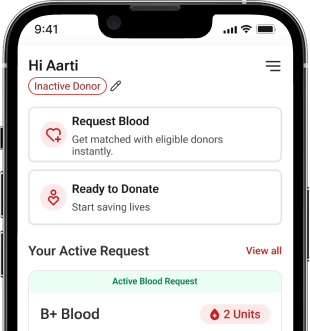
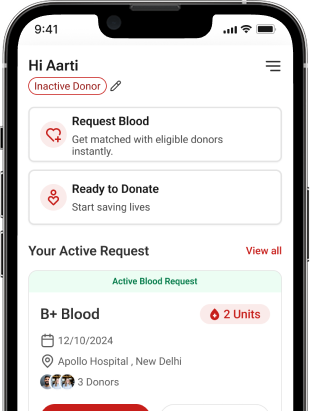
When a hospital or patient registers an urgent blood request, the app identifies registered donors within a defined radius — typically 10–20 km — whose blood type matches. These donors receive an alert immediately. A willing donor in the same neighbourhood can respond within hours.

This is especially powerful in tier-2 and tier-3 cities where hospital blood banks may not carry rare blood types in stock. Research has shown that more than 60% of blood requests on blood donation apps in India come from small towns and villages — precisely the areas where institutional infrastructure is weakest.
For critical, time-sensitive requests — a surgery patient losing blood, a dengue patient with dangerously low platelets, a premature baby needing a transfusion — apps allow hospitals to broadcast urgent alerts to all compatible donors in a region simultaneously. This dramatically reduces the time between request and donation.
Apps like TheBloodApp allow donors to log their donation history and track when they are next eligible to donate. This removes the guesswork and helps build a culture of regular, repeat donation — not just one-time participation in a camp.
The repeat donation problem is real. Studies show that 73% of Indian blood donors are first-time donors — people who gave once and never returned. The national blood supply depends on people who give consistently, every 90 days, year after year. Apps are one of the most effective tools for nudging first-timers into regulars.
Finding a blood bank or donation camp near you in India used to require local knowledge or phone calls. Apps surface this information instantly — filtered by city, by blood type needed, by proximity. For a 22-year-old in Bengaluru or Hyderabad who wants to donate but does not know where to start, this is the difference between donating and not.
A study published in Digital Health (2023) reviewing mobile applications for blood donation found that apps attract younger, more digital-native donors. App users tend to be younger than walk-in donors — with mean ages around 28 for first-time app users versus 31 for those who registered through traditional paper-based systems. This is exactly the demographic that India's blood supply most needs to engage.
The same research found that digital tools showed a consistent trend toward increasing adoption — with usage rates doubling or tripling within 18 months of an app's launch and continuing to grow with sustained awareness campaigns.
The next wave of blood supply technology is already being piloted globally, with early applications being explored in India:
Data analytics and demand forecasting — AI systems that analyse seasonal trends, hospital admission data, and historical donation patterns to predict blood shortages before they happen, allowing proactive collection drives rather than reactive scrambles.
Blockchain for transfusion tracking — blockchain technology can create an immutable, transparent record of every unit of blood from donor to recipient, ensuring accountability and reducing the risk of mislabelling or supply chain errors.
Drone delivery — being tested in several African countries, drone delivery of blood to remote hospitals could eventually be a viable option for India's most inaccessible regions.
Internet of Things (IoT) cold chain monitoring — smart temperature sensors in blood transport and storage that alert blood bank staff in real time if temperature conditions deviate, preventing spoilage.
None of these are science fiction. Some are operational in other countries. India's scale and urgency make it a logical next frontier.
Technology solves connection problems. It does not solve cultural ones.
The myths that stop millions of eligible Indians from donating — fear of weakness, fertility concerns, confusion about eligibility — are not solved by an app alone. Sustained, grassroots awareness efforts are still needed.
The seasonal donation slump — when college campuses empty and camps stop running — requires year-round community engagement, not just digital platforms.
The infrastructure gaps — districts without blood centres, blood banks without cold chain reliability, rural hospitals without storage — require policy and investment, not apps.
But within these constraints, technology has already changed what is possible. A patient in a small town in Madhya Pradesh can now reach a voluntary O– donor in the same district within hours. A first-time donor in Mumbai can be reminded, automatically, when they are eligible again three months later. A thalassemia child's family can see which blood bank has the right type available without calling fifteen numbers.
These things matter. They save time. They save lives.
TheBloodApp is built around this vision — using technology to make blood donation faster, easier, and more responsive to real needs. Whether you are a donor wanting to register and be available when your blood type is needed, or a family member trying to find blood for a loved one urgently, the platform connects you to the right people faster than any traditional system can.
Download TheBloodApp today. Register as a voluntary donor, set your location and blood type, and be part of India's most responsive blood donation network. To make an urgent blood request or find a donation centre near you, call the number listed in the app.
Sources: BMJ Global Health — Blood Deserts in Northern India | eRaktKosh — Ministry of Health and Family Welfare | Global Citizen — Indian Blood Donation Apps | Digital Health Journal — Apps for Blood Donation | IRJMETS Research Paper on Blood Donation Technology | Observer Research Foundation — Blood Supply in India
Stay informed, stay inspired — your go-to source for everything about blood donation and impact.

Had a drink last night? Planning to donate tomorrow? Here's how long to wait after drinking alcohol before donating blood in India — and why the rule exists.

रक्तदान करने से मरीजों की जान बचती है — लेकिन दाता को भी कई स्वास्थ्य लाभ होते हैं। हृदय स्वास्थ्य, कैंसर का कम खतरा, मुफ्त स्वास्थ्य जांच और भी बहुत कुछ।

Worried about blood group compatibility before marriage? ABO type has no bearing on it, but the Rh factor does matter in pregnancy. Here's the full picture.


Be a part of the change — donate safely, stay connected, and help someone in need. Download the app today.
Available on