
No one plans for the call that says there is an accident, or the test results that say surgery cannot wait, or the midnight visit to a hospital where a doctor tells you they need two units of B– blood within the hour.
When it happens — and for millions of Indian families it does — the next few hours are a blur of phone calls, WhatsApp messages, and blind searches. Most people have no idea where to start. Many waste critical time calling the wrong numbers, reaching blood banks that are closed, or looking for blood types that are simply not in stock at the nearest facility.
This guide is for that moment. Read it before you need it. Save it. Share it.
The moment a doctor tells you a transfusion is required, ask them to confirm — in writing if possible:
If the patient's blood type is unknown and there is no time to test, hospitals in India will typically use O negative blood — the universal donor type — for immediate emergency transfusion. This is standard protocol.
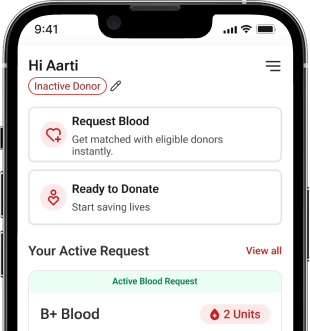
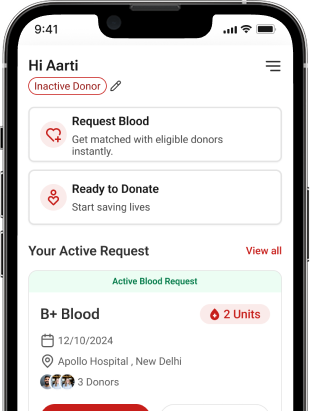
TheBloodApp is designed precisely for this situation. Open the app, enter the blood type needed and your location, and submit an urgent blood request. The platform immediately:
In cities like Delhi, Mumbai, Bengaluru, Chennai, Hyderabad, Kolkata, and Pune, response times through blood donation apps can be remarkably fast — often under a few hours for common blood types.
For rare blood types (O–, AB–, Bombay group), the app's registered donor network becomes even more critical. Rare type donors who have pre-registered are alerted immediately, which is faster than any manual search.
To make an emergency blood request or contact the TheBloodApp team directly, call the number listed in the app.
The government's eRaktKosh platform (eraktkosh.mohfw.gov.in or the eRaktKosh app) allows you to:
This is particularly useful when you need to identify which nearby blood bank currently has your required blood type in stock — avoiding wasted trips to facilities that are empty or closed.
Search for your city, select your blood type, and call the blood banks shown with available units directly.
While apps and portals are the fastest first step, sometimes the fastest path is a direct phone call. Here is how to approach it:
"I need [X] units of [blood type], [component — whole blood / packed RBCs / platelets / plasma], urgently for a patient at [hospital name]. The patient needs it [today / within X hours]. Do you have this available? Can we arrange a direct pickup or delivery?"
Be specific. Blood banks manage limited stock and need accurate information to help you quickly.
India has a robust network of blood donation NGOs and volunteer groups that operate 24/7 and maintain databases of regular donors for emergency situations. Many of them respond faster than official systems because their networks are community-built and highly motivated.
Some well-known options include:
Many hospitals — particularly large government hospitals and major private chains — have their own blood banks that may have the required type in stock or can initiate an emergency procurement.
In government hospitals like AIIMS Delhi, Safdarjung Hospital, or PGI Chandigarh, the blood bank is equipped for high-volume emergencies. Private hospitals with large surgical departments (Apollo, Fortis, Manipal, Medanta) also maintain blood bank infrastructure.
Always ask the treating doctor or hospital administration to check their internal blood bank before you begin an external search. They may already have what is needed.
If no voluntary donor can be found through apps, NGOs, or blood bank stock in time, replacement donation — where a family member or friend donates blood to replenish the hospital's supply — is still practised in India.
Replacement donors do not have to match the patient's blood type directly. They donate to the blood bank's general stock, and the bank releases a unit of the required type to the patient. The math is sometimes more complicated than it sounds, but in urgent situations, hospitals will guide you through it.
While replacement donation is not the ideal model (voluntary, pre-tested blood is safer and more reliable), it remains a functional emergency option in Indian hospitals.
The best emergency response starts before the emergency happens. Here is what every family should have on hand:
Know your blood type — and the blood types of all family members. Get it done during a routine health check if you do not already know.
Register family members as donors on TheBloodApp — especially anyone with rare blood types. Registered donors are easier to contact in an emergency and contribute to the supply chain year-round.
Save key phone numbers — the nearest blood bank, the government's eRaktKosh helpline, and any local NGO blood donation groups in your city.
Know your hospital's blood bank number — if you or a family member has a chronic condition requiring regular transfusions, have the blood bank contact on speed dial.
Every voluntary donor who registers today is a potential emergency resource for tomorrow.
India's blood supply crisis is not just about collection numbers. It is about having the right blood type, in the right place, at the right moment — which requires a large, distributed, pre-registered network of voluntary donors spread across every city, district, and town.
That is what TheBloodApp is building. A live network of donors who are ready to respond, whose information is current, and whose blood type and location are already known when an emergency arises.
The person who registers today may be the match that saves a life at 3 am three months from now.
Download TheBloodApp to register as a voluntary donor or submit an urgent blood request. For emergency support and to find blood donation camps and blood banks across India — Delhi, Mumbai, Bengaluru, Chennai, Hyderabad, Kolkata, Pune and beyond — call the number listed in the app. Do not wait for the emergency to begin.
Sources: eRaktKosh — Ministry of Health and Family Welfare | NBTC Blood Transfusion Guidelines | Global Citizen — Blood Donation Apps India | BMJ Global Health — Blood Access in Northern India | Observer Research Foundation — Blood Supply India | BloodSaathi Platform | Wikipedia — Blood Donation in India
 Blood Donation for Liver Disease: How Hepatitis, Cirrhosis and Liver Transplant Patients Depend on Donors17 Sep 2026
 Blood Donation and Kidney Disease: What Dialysis Patients and Kidney Donors Need to Know27 Aug 2026
 Blood Donation for Children: Why Paediatric Patients in India Need a Dedicated Supply10 Jul 2026
Stay informed, stay inspired — your go-to source for everything about blood donation and impact.

Had a drink last night? Planning to donate tomorrow? Here's how long to wait after drinking alcohol before donating blood in India — and why the rule exists.

रक्तदान करने से मरीजों की जान बचती है — लेकिन दाता को भी कई स्वास्थ्य लाभ होते हैं। हृदय स्वास्थ्य, कैंसर का कम खतरा, मुफ्त स्वास्थ्य जांच और भी बहुत कुछ।

Worried about blood group compatibility before marriage? ABO type has no bearing on it, but the Rh factor does matter in pregnancy. Here's the full picture.


Be a part of the change — donate safely, stay connected, and help someone in need. Download the app today.
Available on