
Delhi is one of the most medically active cities in India. With some of the country's largest government hospitals — AIIMS, Safdarjung, RML, Lok Nayak — and a dense network of private healthcare facilities, the demand for blood in the National Capital Region is enormous, constant, and year-round.
And yet, like every Indian city, Delhi struggles with the same fundamental problem: not enough voluntary, regular blood donors.
Whether you are looking to donate blood in Delhi for the first time, urgently need blood for a patient, or want to understand how Delhi's blood system works — this guide covers it all.
Delhi NCR is home to over 32 million people and functions as a referral hub for patients from across northern India — UP, Haryana, Rajasthan, Punjab, Bihar, and Uttarakhand. Patients with complex conditions, rare diseases, and major surgical needs travel to Delhi because that is where the specialists are.
This creates a blood demand profile that is unlike most Indian cities. AIIMS New Delhi alone performs thousands of complex surgeries annually, each potentially requiring multiple units of blood. Major trauma centres like Safdarjung and LNJP Hospital serve as the primary referral points for road accident victims — a category that requires urgent, large-volume transfusions.
The Indian Red Cross Society, National Headquarters Blood Centre in New Delhi — one of the most active blood banks in the country — collected and prepared nearly 48,769 blood and blood components in the year 2023–24 alone. Of these, approximately 14,714 units were issued at no charge to patients in government hospitals, thalassemia children, and haemophilia patients.
At any given time, Delhi's blood banks collectively serve hundreds of thalassemia patients registered with facilities like IRCS NHQ (which tracks approximately 900 thalassemia cases — roughly 50% of all registered thalassemia patients in the capital), cancer patients, trauma victims, and surgical cases.
Delhi has one of the densest concentrations of blood banks in India. Key facilities include:
1. Government Blood Banks:
2. Indian Red Cross Society:
3. Private Hospital Blood Banks:
Blood donation camps in Delhi are organised throughout the year by:
The peak months for camps are October–February — the cooler season when donor turnout is highest and when post-monsoon dengue cases have subsided. Summer months (April–June) see a sharp drop in collections, making it especially important for non-camp donors to visit blood banks independently during this period.
Any government or private blood bank in Delhi accepts walk-in donors during operating hours. Call ahead to confirm timings and that they have the equipment for the type of donation you want (whole blood vs. platelet apheresis).
Keep an eye on IRCS NHQ announcements, your organisation's notice boards, or platforms like TheBloodApp, which lists upcoming donation camps in Delhi filtered by location and date.
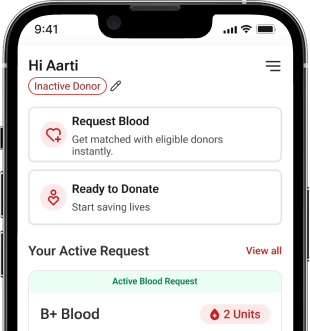
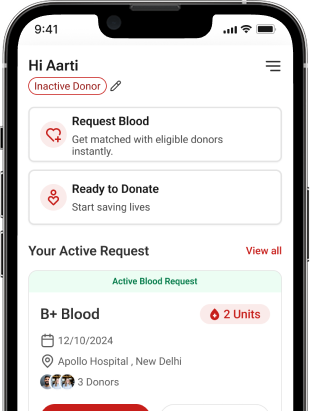
Register as a voluntary donor with your blood type and Delhi location. When a hospital or patient urgently needs blood matching your type anywhere in Delhi NCR, you receive an alert directly. This is the fastest way to ensure your donation reaches someone who needs it right now, not just someone who might need it eventually.
If you or a family member needs blood urgently in Delhi, here is the fastest path:
To make an urgent blood request in Delhi or find donation camps near you, call the number listed on TheBloodApp.
Delhi has one of the largest concentrations of registered thalassemia patients in India, with IRCS NHQ alone tracking roughly 900 cases. These patients need blood every 3–4 weeks, without exception, year-round.
The IRCS NHQ Blood Centre provides antibody-screened, Rh-matched, and leucodepleted packed RBCs to thalassemia patients — a higher standard of blood preparation that reduces the risk of transfusion reactions in long-term transfusion-dependent patients. A total of 14,714 units were issued free of charge to thalassemia, haemophilia, and other vulnerable patients in 2023–24.
If you have a family member with thalassemia in Delhi, establishing a relationship with a blood bank — and building a network of regular voluntary donors through TheBloodApp — is the most reliable long-term strategy for consistent access to safe blood.
Delhi's donor pool is dominated by young men, college students, and corporate employees who participate in organised camps. Women donors remain significantly underrepresented — a national pattern that is especially acute in Delhi.
The working-age professional population of Delhi NCR — IT employees in Gurugram and Noida, government workers, business owners — represents an enormous untapped voluntary donor base. If even a fraction of Delhi's roughly 20 million working-age adults donated once every three months, the capital's blood shortages would end.
Awareness is the barrier. And that is exactly the barrier that registration platforms and targeted alerts — like those from TheBloodApp — are designed to remove.
Every April through June, Delhi's blood banks face their most acute shortages. University exams empty campuses that normally supply large volumes through NSS camps. Heat and Ramadan fasting reduce donor turnout. Families travel for summer vacations.
Blood, meanwhile, does not take a summer break. Road accidents peak in summer heat. Thalassemia children need their monthly transfusions regardless of the season. Surgical queues at Delhi's government hospitals continue without pause.
Donating blood between April and June in Delhi is one of the highest-impact things an eligible donor can do. Blood banks across the capital are most understocked during exactly these months.
The Delhi government and central health authorities have been expanding blood infrastructure — new storage centres, digital integration, and mobile blood collection vans. In 2024, drone-based blood delivery trials were conducted by ICMR in the Delhi-NCR area, a sign of what coordinated logistics could eventually look like.
But technology and infrastructure are enablers, not replacements. Every improvement in the system is only as useful as the blood that is in it — and blood only comes from donors who show up.
Download TheBloodApp. Register as a Delhi blood donor. Respond when an alert comes. And if you manage a company, college, or housing society in Delhi NCR — consider organising a blood donation camp. It takes a morning. It saves lives all year.
To learn how to register or organise a camp in Delhi, call the number listed in the app.
Sources: Indian Red Cross Society NHQ Blood Centre — Annual Report 2023–24 | DDU Hospital Blood Bank, Delhi | AIIMS New Delhi | eRaktKosh — Ministry of Health | WHO India Blood Safety Report 2024 | IndiaSpend — Blood Donation in India | ORF — India Blood Supply
Stay informed, stay inspired — your go-to source for everything about blood donation and impact.

Had a drink last night? Planning to donate tomorrow? Here's how long to wait after drinking alcohol before donating blood in India — and why the rule exists.

रक्तदान करने से मरीजों की जान बचती है — लेकिन दाता को भी कई स्वास्थ्य लाभ होते हैं। हृदय स्वास्थ्य, कैंसर का कम खतरा, मुफ्त स्वास्थ्य जांच और भी बहुत कुछ।

Worried about blood group compatibility before marriage? ABO type has no bearing on it, but the Rh factor does matter in pregnancy. Here's the full picture.


Be a part of the change — donate safely, stay connected, and help someone in need. Download the app today.
Available on